What Yuzu, Hinoki, and Sakura Are Actually Doing to Your Stressed American Brain
When most Americans think of stress relief, they picture a glass of wine, a weekend hike, or perhaps a familiar lavender candle from a home goods store. These are not ineffective tools. But they are, in the language of neuroscience, relatively blunt instruments. What researchers studying olfactory processing have begun to document — and what Tokyo's wellness culture has understood intuitively for centuries — is that the specific aromatic compounds found in Japanese botanical traditions interact with the human nervous system in ways that are both measurable and profound.
This is not a conversation about pleasant smells. This is a conversation about the architecture of your brain.
The Olfactory Pathway: Your Brain's Fastest Route to Calm
Unlike every other sense, smell does not pass through the thalamus — the brain's central relay station — before reaching higher processing centers. Instead, olfactory signals travel directly to the limbic system, the emotional and memory hub of the brain that also governs the stress response. This anatomical shortcut means that scent reaches the amygdala and hippocampus faster than any other sensory input, triggering physiological changes before conscious thought has time to intervene.
For a nervous system that has spent years absorbing the relentless stimulation of American professional and digital life — the pinging notifications, the compressed deadlines, the curated noise of social media — this direct pathway is significant. It means that the right aromatic compounds, delivered in the right context, can begin modulating cortisol levels and activating the parasympathetic nervous system within minutes of first contact.
The question, then, is not whether aromatherapy works. A growing body of peer-reviewed research confirms that it does. The more interesting question is which aromatic compounds work most effectively, and why the botanical ingredients central to Japanese wellness traditions appear to produce outcomes that Western counterparts often struggle to match.
Hinoki Cypress: The Forest in a Single Breath
Hinoki cypress — Chamaecyparis obtusa — is a tree native to Japan that has been used in temple construction, ritual bathing, and therapeutic contexts for more than a millennium. Its essential oil contains high concentrations of alpha-pinene and bornyl acetate, compounds that have been the subject of serious scientific inquiry in recent years.
Research conducted in Japan on the practice of shinrin-yoku, or forest bathing, has demonstrated that exposure to phytoncides — the volatile organic compounds emitted by coniferous trees, including hinoki — produces statistically significant reductions in salivary cortisol, blood pressure, and sympathetic nervous system activity. One study published in Environmental Health and Preventive Medicine found that participants who inhaled hinoki-derived compounds showed measurable increases in natural killer cell activity, a marker of immune function that declines sharply under chronic stress.
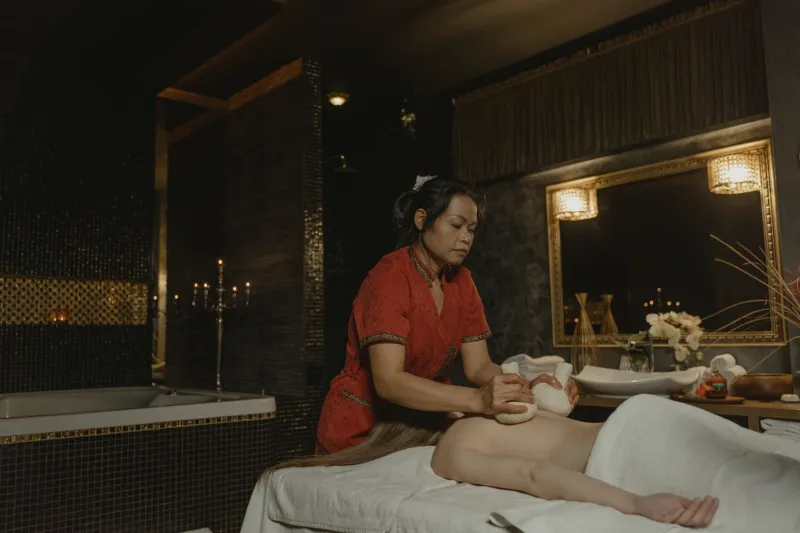
When hinoki oil is incorporated into a therapeutic massage setting — where it is warmed, diffused, and applied through sustained manual pressure — those effects are compounded. The skin absorption of bioactive compounds works in concert with the olfactory response, creating a dual-pathway intervention that few Western essential oils can replicate with the same specificity.
Yuzu: Citrus With an Unusual Neurological Signature
Yuzu is a citrus fruit cultivated across Japan whose essential oil occupies a distinct aromatic territory — simultaneously bright and deeply grounding, with a complexity that defies easy comparison to lemon or orange. That complexity has a biochemical basis. Yuzu oil contains a broader array of volatile compounds than most Western citrus essences, including limonene, linalool, and gamma-terpinene, each of which interacts with olfactory receptors in slightly different ways.
A study published in the Journal of Alternative and Complementary Medicine found that inhalation of yuzu essential oil for ten minutes produced significant reductions in tension, anger, and fatigue among female participants, with effects persisting well beyond the inhalation period. The researchers attributed this to yuzu's influence on the autonomic nervous system, specifically its capacity to shift the balance from sympathetic dominance — the fight-or-flight state that most Americans inhabit chronically — toward parasympathetic recovery.
In Tokyo's wellness culture, yuzu is not used in isolation. It is blended with complementary botanicals according to principles that prioritize harmony between stimulating and sedating compounds. This blending philosophy, rooted in traditional Japanese aesthetics of balance, produces aromatic profiles that Western single-note applications rarely achieve.
Sakura and the Neuroscience of Emotional Safety
Sakura — cherry blossom — occupies a unique position in Japanese culture and, increasingly, in aromatherapy research. Its aromatic compounds, including geraniol and benzaldehyde, have been associated with anxiolytic effects in animal studies, and the cultural context in which sakura is experienced in Japan adds a dimension that neuroscientists are beginning to take seriously.
The concept of mono no aware — the bittersweet awareness of impermanence symbolized by the cherry blossom — creates an emotional framework around sakura that may itself be therapeutically significant. Research in the field of psychoneuroimmunology has established that emotional context shapes physiological response. When an aromatic compound is experienced within a cultural narrative that promotes acceptance, presence, and the release of control, the nervous system responds differently than it does when the same compound is encountered without that framework.
For Americans accustomed to treating relaxation as another item on the productivity checklist, this contextual dimension is precisely what is missing from even the most well-appointed domestic spa experience.
Why Tokyo Changes the Equation
The neuroscience of aromatherapy does not operate in a vacuum. The setting in which therapeutic scent is delivered — the ambient sound, the temperature, the quality of touch, the practitioner's training, and the cultural philosophy underlying the treatment — all influence how the nervous system receives and processes the intervention.
Tokyo's wellness culture integrates these variables with a precision that reflects centuries of refinement. The oils used in a Japanese aromatherapy massage are not selected arbitrarily or sourced from generic supply chains. They are chosen for their botanical specificity, their regional provenance, and their compatibility with the treatment's intended physiological outcome. The blending is deliberate. The application is skilled. The environment is designed to minimize competing stimuli and maximize the conditions for genuine nervous system recovery.
For Americans who have tried every domestic wellness product and still cannot seem to fully decompress, this is worth understanding: the problem may not be your capacity for relaxation. It may be that the tools you have been offered were never quite calibrated for the depth of reset your nervous system actually requires.
Tokyo's aromatic traditions were not developed for the casually stressed. They were developed for human beings carrying the full weight of a demanding life. That is a distinction your brain — and your body — will recognize the moment the session begins.