Tokyo Is Replacing Vegas as America's Favorite Spa Escape — and It's Not Hard to See Why

Photo by Photo by note thanun on Unsplash on Unsplash
Tokyo Is Replacing Vegas as America's Favorite Spa Escape — and It's Not Hard to See Why
For years, the American wellness weekend followed a familiar script. Book a suite at a resort in Las Vegas, Scottsdale, or Miami. Reserve a Sunday afternoon massage between brunch and checkout. Emerge mildly refreshed, return to routine, and repeat the cycle in three months when the tension becomes impossible to ignore again.
This model has served its purpose. But something is shifting. Quietly, and then quite noticeably, a segment of American travelers has begun opting out of the domestic luxury circuit entirely — boarding long-haul flights to Tokyo, building itineraries around wellness treatments, and returning home describing something that sounds less like a vacation and more like a genuine transformation.
The question worth asking is not whether this trend is real. It clearly is. The more interesting question is why.
The Transactional Spa and Its Limitations
American spa culture, at its best, is impressively polished. The facilities are immaculate, the menus are extensive, and the service is attentive in a way that leaves little room for complaint. But there is a quality to the experience that is difficult to ignore once you have noticed it: it is, fundamentally, transactional.
You purchase a unit of relaxation. It is delivered with professionalism and efficiency. You leave. The experience is pleasant, sometimes genuinely restorative, but it rarely challenges your understanding of what rest actually means. The surrounding environment — the casino floor, the airport terminal, the resort pool — continues to operate at full stimulation, and the massage room exists as a brief parenthesis within that noise rather than an alternative to it.
This is not a criticism of American hospitality so much as an observation about cultural context. In the United States, relaxation is generally framed as a reward — something earned after productivity, consumed between obligations, and optimized for efficiency. A 60-minute session that fits neatly into a busy schedule is the ideal. The goal is recovery, delivered on a timeline.
What Tokyo Understands Differently
Japanese wellness philosophy does not begin with the assumption that restoration is a product. It begins with the understanding that the conditions surrounding an experience are inseparable from the experience itself.
This is visible in the architecture of Tokyo's finest spas — spaces designed not merely to look calming, but to function as genuine environments of decompression. It is present in the unhurried pace of a session, where a therapist works without the implicit pressure of the next appointment bleeding into your hour. It is evident in the attention paid to sensory detail: the temperature of a room, the weight of a blanket, the specific aromatic profile of an oil blend chosen to match your stated needs rather than a standard menu option.
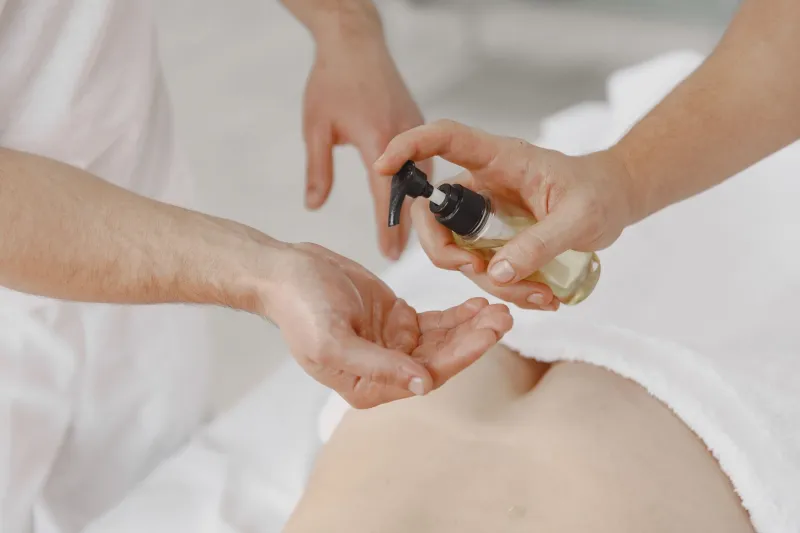
Aromatherapy massage in Tokyo, practiced at its highest level, is not a service appended to a trip. It is a philosophy of care applied with rigor. The essential oils — many derived from botanicals native to Japan, such as hinoki cypress, yuzu, and camellia — carry cultural and historical weight that deepens the experience beyond the merely pleasant. A session becomes, in some meaningful sense, an encounter with a different way of understanding the human body and its relationship to rest.
The Journey as Part of the Healing
There is something else worth acknowledging, something that wellness industry discourse tends to overlook: the act of traveling far to seek restoration carries its own therapeutic logic.
When an American books a spa afternoon at a domestic resort, the surrounding context remains largely unchanged. The same phone, the same news cycle, the same professional obligations — all of them hovering just outside the treatment room door. The psychological distance between daily life and genuine rest is minimal, which means the effort required to actually arrive at stillness is significant.
A long-haul flight to Tokyo enforces a different kind of transition. The time zone shift, the physical distance, the immersion in a city that operates by entirely different rhythms — all of these function as a kind of preparatory unwinding before the massage table is ever encountered. By the time a traveler settles into an aromatherapy session in Tokyo, they have already undergone a process of displacement from their ordinary mental state. The treatment, when it arrives, meets a person who is genuinely ready to receive it.
This is not incidental. It is, in fact, one of the most compelling arguments for international wellness travel as a category — and for Tokyo specifically, where the city's own atmosphere of disciplined calm, its extraordinary food culture, its walkable neighborhoods and meditative temples, all conspire to extend the restorative experience well beyond any single appointment.
A Shift in What Americans Are Asking For
The travelers making this transition are not, on the whole, rejecting luxury. Tokyo's premier wellness establishments offer an exceptionally high standard of comfort and service. What these guests are rejecting is the simulation of restoration — the kind that looks the part without delivering the substance.
They are asking, increasingly, for experiences that change something. That leave them not merely rested but recalibrated. That offer not just a break from daily life but a genuine reorientation toward it.
Tokyo, with its unique synthesis of ancient wellness tradition and contemporary precision, answers that request with unusual authority. The city does not simply offer a place to relax. It offers a context in which relaxation becomes possible in a deeper, more durable sense.
The Case for Making the Journey
No domestic spa weekend — however well-appointed — can replicate what Tokyo offers to the traveler who arrives with genuine intention. The distance is real, the investment is real, and the commitment required is greater than booking a Sunday afternoon slot between checkout and the airport shuttle.
But the return on that commitment is proportionally greater as well. Americans who have made the journey describe not a vacation from which they needed to recover, but an experience that genuinely restored their capacity to engage with their lives. That distinction matters enormously — and it is increasingly driving the itineraries of travelers who have decided that wellness is not an amenity. It is the destination itself.