Ancient Scent, Modern Science: Why Tokyo's Aromatic Healing Tradition Is Doing What Stress Clinics Cannot

Ancient Scent, Modern Science: Why Tokyo's Aromatic Healing Tradition Is Doing What Stress Clinics Cannot
There is a particular kind of exhaustion that no American doctor's office seems equipped to address. You describe it carefully — the tightness behind the eyes, the sleep that never fully restores, the low-grade anxiety that hums beneath every productive day — and what you receive in return is a pamphlet about sleep hygiene, perhaps a referral, perhaps a prescription. What you do not receive is relief.
In Tokyo, the approach to this same constellation of symptoms looks entirely different. It begins not with a clipboard, but with scent.
The Philosophy That Western Medicine Overlooked
For centuries, Japanese healing culture has operated on a foundational premise that Western clinical practice has been slow to adopt: that the body and mind are not separate systems requiring separate interventions, but a single, deeply integrated whole. This philosophy, embedded in the ancient tradition of Kampo — Japan's adaptation of classical Chinese herbal medicine — holds that therapeutic substances, including aromatic botanicals, act on the entire organism simultaneously.
Kampo practitioners have long catalogued the psychophysiological effects of specific plant compounds. Hinoki cypress, for instance, was understood to quiet what traditional texts described as excessive ki — the vital energy associated with agitation and mental restlessness. Yuzu, the citrus fruit whose rind produces one of Japan's most distinctive aromatic oils, was regarded as a harmonizer of emotional states, particularly useful during periods of transition or grief. Sandalwood and camphor were employed in ceremonial and medicinal contexts alike, their calming properties considered as reliable as any herb taken internally.
What strikes the modern observer is not merely that these traditions existed, but that they persisted — refined across generations of careful observation — long before randomized controlled trials existed to validate them.
What Happens When Scent Enters the Nervous System
Here is the anatomical reality that gives aromatherapy its pharmacological legitimacy: olfactory receptors in the nasal cavity connect directly to the limbic system, the brain's emotional and memory processing center, via the olfactory nerve. This pathway bypasses the blood-brain barrier entirely. No pill, regardless of how precisely formulated, travels this route.
When a therapeutic aromatic compound — say, the linalool present in lavender, or the alpha-pinene abundant in hinoki — enters the nasal passage, it triggers an electrochemical cascade that reaches the amygdala and hippocampus within milliseconds. These are the structures responsible for regulating fear responses, stress reactivity, and emotional memory. The nervous system does not need to metabolize what it has already received.
Research published in peer-reviewed journals has confirmed measurable reductions in cortisol — the body's primary stress hormone — following controlled aromatherapy sessions. Separate studies have documented changes in autonomic nervous system activity, specifically a shift from sympathetic dominance (the fight-or-flight state in which most overstressed Americans spend the majority of their waking hours) toward parasympathetic activation — the physiological condition of genuine rest and repair.
A pharmaceutical anxiolytic works, when it works, by manipulating neurotransmitter availability through the bloodstream. Aromatherapy works by speaking directly to the brain's oldest, most primal language: chemical signal through air.
How Tokyo Wellness Spaces Apply This Knowledge
At Diana Tokyo Aroma Massage, the aromatic protocols offered to guests are not assembled arbitrarily. Each blend draws on both classical Kampo principles and contemporary understanding of essential oil chemistry to address specific physiological and emotional states.
A guest presenting with the particular nervous exhaustion common to high-achieving American professionals — what practitioners here sometimes describe as the paradox of a mind that cannot stop working even when the body has stopped moving — might receive a session centered on a hinoki and vetiver base, compounds recognized for their grounding, cortisol-modulating properties. The session itself is structured to engage the parasympathetic nervous system progressively: beginning with lighter, more stimulating top notes that gently redirect mental activity, transitioning toward deeper, resinous base notes that anchor the body in the present moment.
For guests whose stress manifests as emotional numbness or disconnection — a presentation increasingly common among those who have been managing chronic pressure for years without adequate recovery — blends incorporating yuzu, bergamot, and a touch of rose absolute are employed. These compounds have documented effects on serotonin pathway activity and are associated in both traditional and contemporary literature with emotional warmth and the gentle restoration of sensory aliveness.
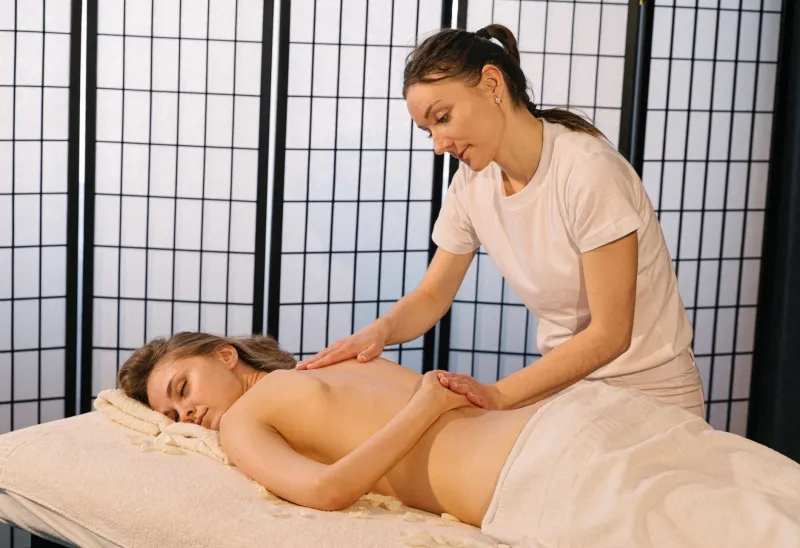
The distinction from Western clinical aromatherapy, where essential oils are often used as ambient background rather than as the primary therapeutic agent, is significant. In Tokyo's more sophisticated wellness spaces, scent is the medicine. Everything else — the pressure of skilled hands, the temperature of the treatment room, the quality of silence — serves to amplify its effect.
The Question American Wellness Culture Has Been Avoiding
The United States spends more per capita on healthcare than any other developed nation. It also reports some of the highest rates of chronic stress, anxiety disorder, and sleep dysfunction in the industrialized world. These two facts exist in uncomfortable proximity.
Part of what makes Tokyo's approach to stress and nervous system dysregulation so instructive is not merely its effectiveness, but its underlying logic. Japanese wellness culture does not treat the absence of disease as the presence of health. It treats vitality — genuine, embodied, sensory aliveness — as the standard. A person who is not sick but who is also not well, who moves through their days depleted and defended and faintly numb, is understood to require care. That care need not be dramatic. It need not involve a diagnosis or a prescription or a referral to a specialist.
Sometimes it requires only the right scent, delivered by skilled hands, in a space designed to remind the nervous system that it is, in fact, safe.
What You Carry Home
One of the more remarkable aspects of scent-based healing is its durability. Because aromatic compounds work through olfactory-limbic pathways so deeply connected to memory formation, therapeutic experiences involving significant scent exposure tend to leave neurological traces that other forms of treatment do not. Guests who have received a carefully designed aromatherapy session frequently report that the associated sense of calm can be partially re-accessed simply by encountering the same aromatic notes again — in a candle, in a diffuser, in the air of a Japanese bath.
This is not metaphor. It is the predictable consequence of how scent and memory are encoded in the human brain.
The aromatherapy prescription no doctor will write you is not, in the end, a mystery. It has existed for centuries in the botanical pharmacopoeia of Japanese healing tradition. Tokyo's wellness practitioners have simply continued to honor it — and the nervous systems of those who seek them out continue, reliably, to respond.